

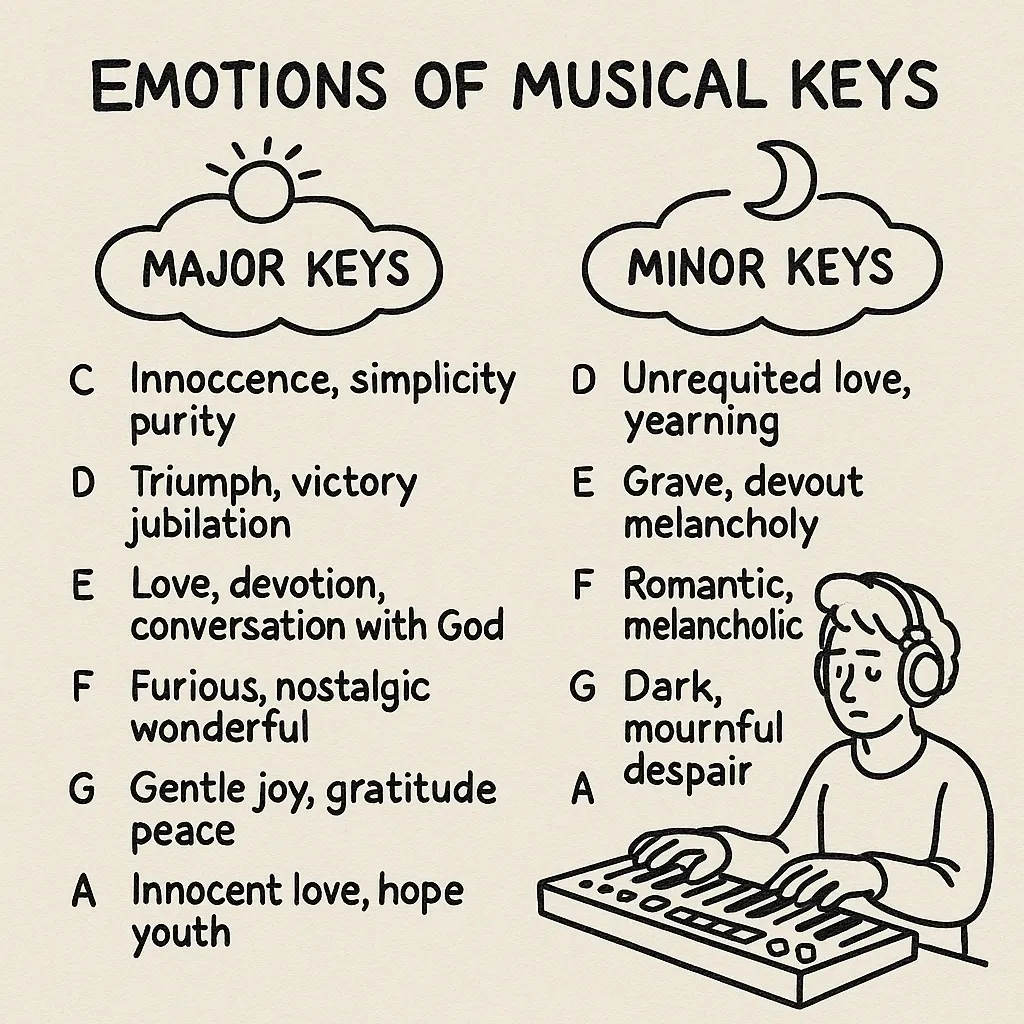
The Emotional DNA of Keys
I played a song to a friend and immediately he got the sentiment, of the song. He’s a smart guy, a DJ, Producer and Engineer so his ear is well trained. He said “I bet it’s in C Minor” which is about love / unrequited love.
To get this from an electronic track threw me, I was SO impressed but also curious what he meant. So I did some research on this, the emotional DNA of musical keys which you can see here.
In 1806, German composer and poet Christian Friedrich Daniel Schubart published Ideen zu einer Ästhetik der Tonkunst, a treatise that assigned emotional characteristics to each musical key.
These associations, rooted in the tuning systems of the time, have influenced composers for centuries. While modern equal temperament has standardised tuning, many musicians still perceive distinct emotional qualities in different keys.
Understanding these associations can be a powerful tool in music production, especially when using digital audio workstations like Ableton Live. By selecting a key that aligns with the desired emotional tone of a track, producers can craft more intentional and evocative music.

🎼 Major Keys – Bright, Expansive, Upward
- C Major – Innocence, simplicity, purity. Often associated with straightforward, joyful expressions.
- D Major – Triumph, victory, jubilation. Ideal for conveying a sense of grandeur and celebration.
- E Major – Love, devotion, conversation with God. Evokes intense emotional experiences and spiritual depth.LedgerNote
- F Major – Furious, nostalgic, wonderful. Balances passion with a sense of longing.
- G Major – Gentle joy, gratitude, peace. Conveys calmness and contentment.
- A Major – Innocent love, hope, youth. Reflects sincerity and optimism.
- B Major – Strong passion, longing, intense. Expresses deep emotional intensity.
🌘 Minor Keys – Deep, Emotional, Inward
- C Minor – Unrequited love, yearning. Suitable for storytelling with melancholic strength.
- D Minor – Grave, devout, melancholy. Often considered the “saddest” key, conveying deep sorrow.
- E Minor – Romantic, melancholic. Expresses tender sadness and introspection.
- F Minor – Dark, mournful, despair. Evokes feelings of deep grief and lamentation.
- G Minor – Serious, magnificent, discontent. Conveys a sense of noble sorrow and complexity.
- A Minor – Tender, plaintive. Reflects honest sadness and gentle reflection.
- B Minor – Dark, tragic, solitary. Expresses profound melancholy and introspection.
🎛️ Applying Key Characteristics in Ableton Live
By integrating these emotional associations into your production workflow, you can enhance the expressive quality of your music:
- Set Your Intent: Decide on the emotional direction of your track and choose a key that aligns with that mood.
- Utilise Scale Mode: In Ableton Live, enable Scale Mode in the MIDI Clip View to stay within the chosen key, ensuring harmonic consistency.
- Plan Emotional Arcs: Structure your set or album by transitioning through keys that guide the listener on an emotional journey.
🎹 Creative Prompts
- Emotional Mapping: Create a series of loops in different keys, each representing a specific emotion, and arrange them to tell a cohesive story.
- Key Modulation: Experiment with shifting keys within a track to reflect changes in emotional intensity or narrative progression.
- Personal Signature: Identify keys that resonate with your artistic identity and incorporate them consistently to develop a distinctive sound.
By understanding the emotional connotations of musical keys, you can make more informed decisions in your compositions and productions, leading to music that resonates more deeply with listeners.

No Comments